

WANDERLUST
by Anne McPherson Arthurs
Mama always began the story this way: Lila had wanderlust as soon as she let go of the furniture and took her first steps away from me.
She told this tale as proof of my sister’s nature, usually after Lila had done something that was equal parts maddening and impressive. She told it so often I never wondered why she kept repeating it. But the day after Lila’s graduation, when she climbed into her car and drove away in a cloud of gravel dust, Mama told it differently. Or maybe the story didn’t change, but only how I heard the words that lay beneath. Standing in the kitchen facing Mama’s back, in the strange quiet soaking through the room, I heard for the first time the story Mama had been trying to tell me for years.
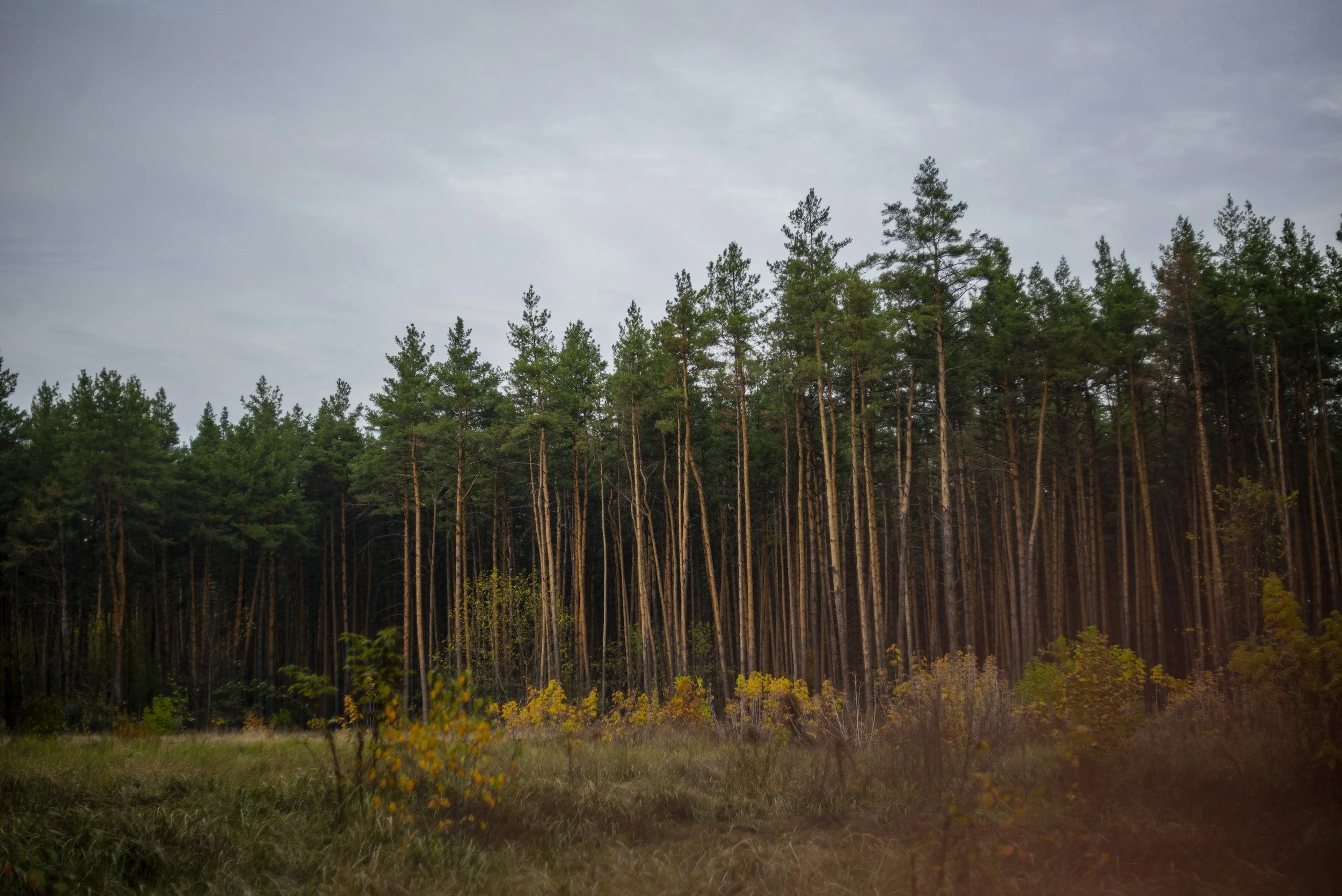
Even before I was born, my sister was drawn to the woods. Any time she was outside with Mama—working in her vegetable garden, watering the flowers, trimming the bushes framing the house or cutting away the weeds that insisted on poking up through them—Lila was prone to toddle off towards the trees. Mama erected a playpen to corral her and opened a huge umbrella to protect Lila’s fair skin while Mama pulled weeds and watered her vegetables.
But Lila quickly grew too big for the playpen and climbed out. The playpen was boring, restrictive, and the wide expanse of lawn was trim and soft like carpet. But once she bored of chasing grasshoppers, she headed for the woods. Papa built my sister a swing set and sandbox to keep her busy in the corner of the yard, but that only worked for so long.
“Stay away from the woods!” Mama warned. “You could get lost, and I would be so sad!”
In all the retellings, I’d only heard the warning in her story, never the plea.
My sister nodded solemnly but it didn’t keep her away. Soon she’d be at the tree line, where the grass met the matting of old leaves, the heavy shade of oak and maple, the tangle of weeds, pricker bushes and undergrowth and mystery. Mama had to keep one eye on her while she worked. Lila was impossible to discipline, the way she just went on and did whatever she wanted anyway. She simply did not exist in a world where the word “no” applied to her. She always looked for a way around it. Mama said this with exasperation, but I think there was fear in it too.
The year I was born, Lila started kindergarten and met Bethany, a skinny, freckled red head who lived a mile down the road. They were immediately drawn to each other—Birds of a feather, Mama called them—and she was all Lila could talk about in those blurry months while Mama managed at home alone with me, her husband perpetually away working.
“She has a dog and a cat,” Lila reported, a bit accusatory since her house contained neither. “She invited me over to play. Can I go?”
“Oh, honey. I’m busy right now.” I’d vomited on her, and she’d been forced to change clothes three times already that day. She worried I wasn’t gaining weight.
“But she asked! She’s waiting for me!” Lila protested, to whom no was just the first step in a negotiation.
And it would go on like this until Mama relented and drove her over and met Bethany’s mother for the first time. You might think the two women would have become friends, what with their being close neighbors, stay-at-home mothers and with girls who were destined to remain friends all though school. But although Mama asked all the usual polite questions you might ask upon meeting a new neighbor—“How long have you lived here?” “Where are you from?” “What does your husband do?”—Bethany’s mother, whose name was Grace, answered the questions simply and failed to offer any more information to start an actual conversation: “Six years.” “I grew up in town.” “He works at the hospital.”
In all the times I spent at Bethany’s house over the years, brought along by Lila to play with Bethany’s younger sister, born two years later, I never observed Grace ask a single question that required more than a five-word answer. I never understood how Bethany’s parents even got together. Her father was a polite, friendly man who nevertheless offered up nothing substantial. Maybe they were both left without a partner at a dance.
Once the mothers met, Lila wanted to go to Bethany’s house every day. Busy with me and wary of Lila becoming an annoyance, Mama said no at least two out of three times.
“But she says it’s okay! And her mommy said I’m welcome ‘any time.’ You heard her!”
“Sometimes people say things just to be polite, Lila. She might get upset if you go every day and stop letting you come at all.”
Five-year-old Lila, who never said anything she didn’t mean, couldn’t understand why someone would do that.
“She loves having me there! She keeps saying how nice Bethany and I play together! How polite I am! She gives me cookies she makes herself! Not like here!” she added spitefully.
“Lila, I’m busy taking care of your sister!” Mama insisted almost desperately. “Babies are a lot of work!”
On cue, I began to cry, waving my fists while my skin went red and splotchy.
“Look what you did, Lila!” Mama said, clutching a wailing me to her sore chest. I was frighteningly hot in my infant rage. “Even if I was okay with you going to Bethany’s house every day—which I am not!” she added to Lila’s opening mouth—“I just don’t have time to drop everything and drive you over there whenever you feel like it!”
Lila took two things away from this conversation: The first was that the real issue wasn’t Mama’s concern over taking advantage of Grace’s hospitality, but rather Mama’s lack of time to drive her over. She set about immediately finding a solution. The second was her decision to make her new sister love her more than Mama, so that I could never be used as an excuse for her not to get what she wanted.
Lila had a bike to ride down to the main road and back. It wasn’t a very exciting trek—the view never changed—but it kept her from wandering the woods so much. It also meant she had a way to get to Bethany’s house. The first time she disappeared on her bike and didn’t come back, Mama didn’t even notice. She’d seen her ride off and didn’t realize how much time had passed until Grace called to tell her Lila had arrived safely.
“She wanted me to let you know,” Grace explained. “She said you’d worry.”
I think this was the part Mama never got over.
She gripped the phone until her knuckles turned white.
“I will be over soon to pick her up,” she replied tightly. She put down the receiver over Grace’s protests and turned to me where I lay on a blanket on the floor, clutching my toes with my hands, a wonderful and recent discovery. “Looks like we’re going to collect your sister.”
When Mama was mad, she got very quiet, and outwardly calm. Harried and frantic was normal. She had a lot to do with two kids and a house in constant need of attention, bread to bake, clothes to sew and mend, a garden to tend. But when she got mad, all that fell away as her fury narrowed.
When Mama showed up that day to load Lila and her bike in the car, Lila was defiant but also wise enough to keep her mouth shut. With Grace and Bethany waving them off, Mama smiled through tight lips and, in a voice so low it rumbled, demanded to know, “What made you think I’d be okay with this?”
Lila lifted her chin. “You didn’t have time to take me. So, I took myself.”
Mama repeated that line for years with a bitterness she tried to pass off as disbelief. Only now did I hear how much of the future was packed into it.
“Riding your bike on this road is very, very dangerous. There are no sidewalks and there are hills. Drivers can’t see you. You could be killed.”
“I walked up the hill in the ditch,” Lila said scornfully. “I pushed my bike. I’m not stupid.”
“Do not ride your bike to their house again.”
So, she didn’t. Lila might defy a direct “No,” she might ignore Mama’s yelling, but she would listen where a good argument could be made. The next time she went, she hiked up the old logging trail that ran from the edge of our backyard through the woods to the back of Bethany’s parent’s yard. Mama herself had walked Lila up and down this road as an adventure before I was born. There was nothing out there that could do any harm, only rabbits and squirrels and birds, the occasional turtle, or deer that would bolt at the sight of you. You couldn’t get lost so long as you stayed on the trail.
Mama could close one path and Lila would find another. I think that’s what exhausted her most.
The next time Grace called to let Mama know Lila had arrived safely, Mama slowly blinked her eyes, took a breath, and thanked her.
This is the story Mama retold the day after Lila’s graduation, when she climbed into her car with Bethany and drove away.
Like that, so simple, like a folded piece of paper, she was gone.
The story wasn’t new, retold in pieces and in whole over time, so often it ought to have gone flat with repetition. Instead, it sharpened. I understood that Mama hadn’t told it to be funny, though sometimes it was, or because she wanted to show how impossible Lila had been, though that was also true. She told it because if Lila had been heading away from us since the very beginning—slipping the fence, finding another path, heading where she pleased—then her leaving was not Mama’s fault. It was simply the farthest distance yet in a journey Lila had been making all her life. And Mama had been watching, from the very start, as love failed to turn her around.